
Surrogate Requirements: See If You Qualify for Surrogacy
Promise is as committed to helping women become a surrogate as we are to connecting intended parents with surrogates. With over 30 years of supporting families and surrogates through successful journeys, we understand this is a significant decision that deserves thoughtful consideration and personalized guidance. If you're interested in becoming a surrogate with us, please review the gestational surrogate requirements listed below.

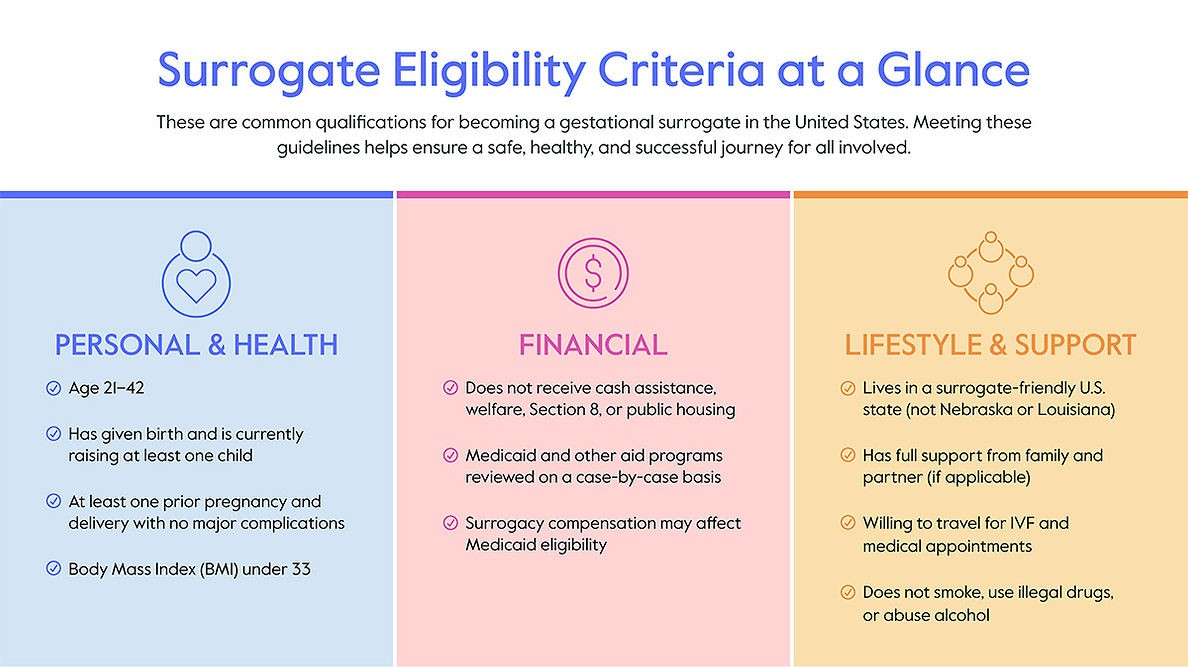
Requirements to Be a Surrogate
These surrogate requirements were created under the guidance of fertility clinics and The American Society for Reproductive Medicine (ASRM). By following these guidelines, 99.1% of our parents go home with a baby — setting you, your intended parents, and their baby up for the most rewarding journey possible.
Personal and Health Requirements for Surrogates
We've found that these requirements support safe, successful pregnancies and positive outcomes for surrogates, intended parents, and babies.
- You are between 21 and 42 years of age.
- You have delivered a child of your own and are currently parenting at least one child.
- You have completed at least one successful pregnancy and birth without complications.
- You have a Body Mass Index (BMI) lower than 33. Calculate My BMI.
- You reside in the United States in a surrogate-friendly state (we cannot accept gestational carriers who reside in Nebraska or Louisiana).
Financial and Legal Requirements for Surrogates
These guidelines exist to protect your family’s financial stability and ensure that surrogacy compensation doesn't unintentionally affect your eligibility for other benefits.
- You cannot participate in certain government aid programs, including cash assistance, welfare, public housing, and Section 8.
- Other forms of government assistance are considered on a case-by-case basis, and we're happy to discuss your family’s specific situation with you.
- You must also have a valid driver's license to meet legal and practical requirements throughout the journey.
Lifestyle and Support Requirements for Surrogates
A rewarding surrogacy journey starts with a strong foundation and a dedication to maintaining your health and well-being.
- You have the support of your family; if you’re married or partnered, you have your partner’s support.
- You’re willing to travel to a fertility clinic for the in vitro fertilization (IVF) process.
- You don’t use illegal drugs, smoke cigarettes, or abuse alcohol.


What Are the Disqualifications for Surrogacy?
When you don’t meet surrogate qualifications, it means you don't meet the standard criteria put forth by fertility clinics to have the best possible chance at a successful surrogate pregnancy for all parties involved. This isn’t a reflection on you as a person — it simply means the journey isn’t the right fit for your current circumstances.
Some general points that can disqualify you from becoming a surrogate include:
- You’re not in the correct age range.
- You haven’t given birth before.
- Your BMI is above the accepted range.
- You don’t live in a surrogacy-friendly state.
- You don’t meet the surrogate medical requirements, such as being a nonsmoker.
- You don’t meet the financial requirements.
- You don’t have the support of family, a spouse, or a partner.
- Your current lifestyle or well-being does not allow for the emotional and mental commitment of surrogacy.
If you're unsure whether you meet these requirements, we're here to help. Our surrogacy application and screening experience are designed to be thorough yet supportive, and we'll walk through your unique situation together. Many questions can best be answered through conversation, and we're committed to providing clear, honest feedback about your path forward, whether that's moving ahead with surrogacy or exploring other options that might be a better fit right now.

Surrogate Requirements FAQs
Below are some common questions about surrogate requirements. You can read our full list of FAQs about the general surrogacy process here.
This is evaluated on a case-by-case basis. However, it's important to understand that the compensation you receive as a surrogate could affect your Medicaid eligibility because of the increased income. This could potentially lead to losing coverage. This is why surrogates who participate in certain government aid programs, such as public housing, are not eligible to serve as surrogates.
When you apply to become a surrogate, you're asked to define your official marital status as single or divorced. If you and your partner are separated but not officially divorced, you may want to wait until your divorce has been finalized. It can be emotionally challenging to engage in surrogacy during separation or immediately following a divorce.
At this time, we are unable to accept applicants who experienced postpartum depression and were treated with antidepressants after their most recent delivery, numerous prior deliveries, or all prior deliveries. If your depression wasn't related to postpartum concerns, we make decisions on a case-by-case basis.
Each state has its own laws and requirements surrounding the surrogacy journey, which can either limit or protect the rights of everyone involved. At this time, we're unable to accept applications from residents of Louisiana or Nebraska.
Yes! Many of our surrogates choose to complete multiple surrogacy journeys with us. We welcome experienced surrogates back with increased compensation and a streamlined screening process. We recommend speaking with your OBGYN about appropriate timing between pregnancies and resubmitting an application to ensure we have your most current information.
Connect With Us to Take the Next Step
Every surrogate's path is unique, and we're here to answer your questions and help you understand what to expect throughout the process. From initial screening to delivery and beyond, we'll be with you every step of the way. Get started with our questionnaire or explore the surrogate process to learn more about the comprehensive support we provide at every stage.
Apply Now